
Cancer treatment saves lives, but it can also have long-term adverse effects that are less talked about – for example, the impact on the ability to have children. Many patients with cancers of the digestive tract, including oesophageal, stomach, pancreatic, liver, bowel and rectal cancers, face problems with their ability to have children after treatment without being fully aware of the risks or having enough information about their options beforehand.
This is the focus of an international questionnaire study in which the Czech Republic plays a key role. The initiator of the project is Tomáš Sokop, M.D., from the MASARYK’S INSTITUTE OF ONCOLOGY (MOU) and member of the CZECRIN Disease ONET ONCO, who was instrumental in the creation of this research and the involvement of Czech patients.
The research is being conducted between April and June 2025 under the direction of Prof. Irit Ben-Aharon MD, PhD, a renowned Israeli oncologist and director of the Fishman Cancer Center at the Rambam Health Care Campus in Haifa, who has long been researching the toxic effects of anticancer treatments on fertility. The questionnaire study also involves leading research teams from Denmark, the Netherlands and Israel.
Why is this study important?
- It will help to find out how cancer treatment affects the ability of patients with digestive tract cancer to have children and whether they have been adequately informed about the potential risks of treatment.
- Your experience will help us to identify gaps in communication between doctors and patients and contribute to better informing patients who may be affected by this topic in the future.
- The aim of the study is not only to collect data, but also to improve care for patients who want to become parents after treatment.
Who can join?
If you are a patient with a gastrointestinal tract (GIT) cancer who has been diagnosed between the ages of 18-45, you can help us by filling out a short questionnaire before 30. 6. 2025.
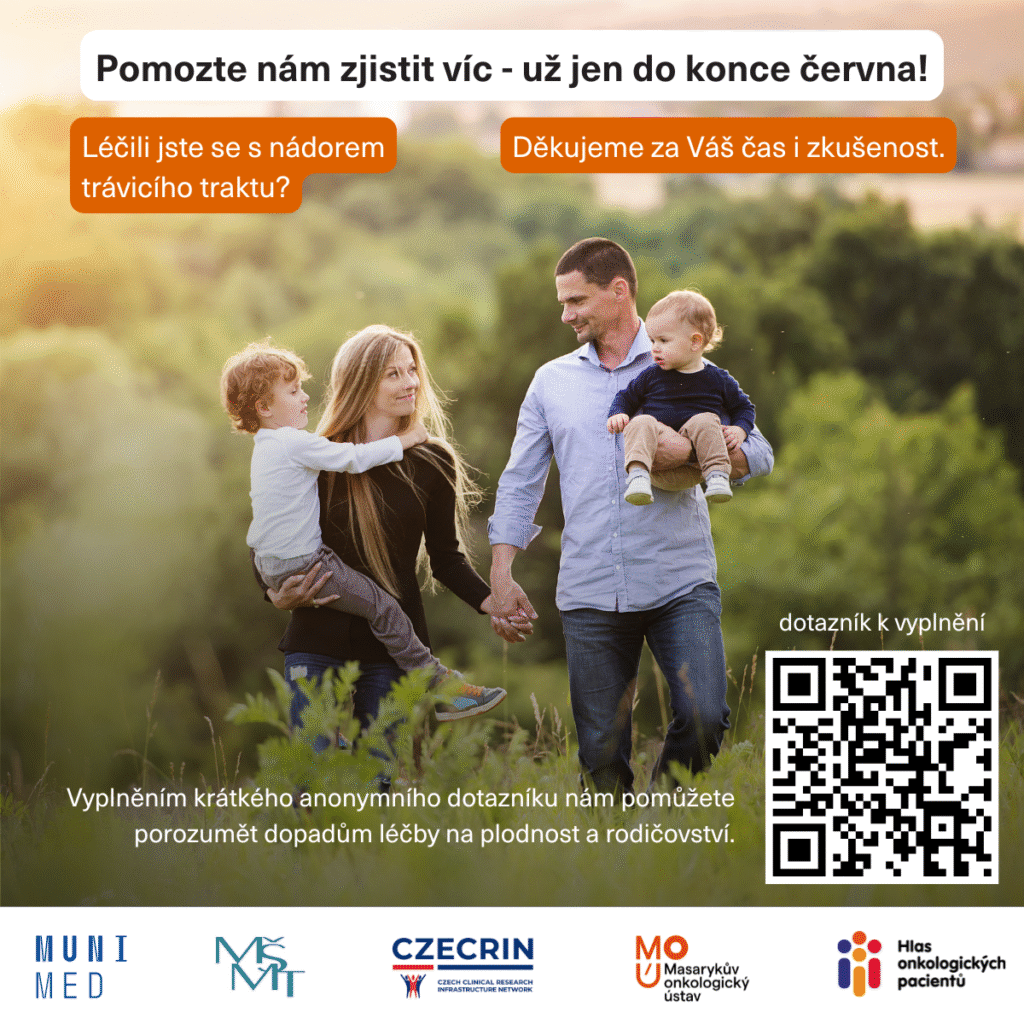
You can fill in the questionnaire here: https://form.jotform.com/250881700688464
Study Support: the important role of CZECRIN in clinical research and healthcare development
The project is implemented with the support of CZECRIN – Czech National Clinical Research Network, which has long provided expert and infrastructural support for clinical trials across all areas of medicine. CZECRIN connects the academic and healthcare sectors, enabling the effective implementation of research projects with a direct impact on the development of healthcare provision.
Thanks to CZECRIN’s support, Czech patients have the opportunity to participate in international clinical trials that bring new knowledge and innovative approaches to treatment. Within this study, CZECRIN plays a key role not only in the professional background, but also in connecting research teams, patient organisations and health care institutions, which enables smooth implementation of the project and ensuring quality outputs.
The data will be collected and evaluated by the research team in an anonymised form, i.e. without the possibility of identifying you in any way. The results can be published in professional journals and presented at scientific conferences.
The voice of patients and their important role in the project
The patient organization Voice of Patients was actively involved in the study through Mgr. Petra ADÁMKOVÁ, Director of ONKO Unie, who has been certified as a patient advocate in the prestigious EUPATI (European Patients’ Academy on Therapeutic Innovation) programme. Her involvement highlights the importance of collaboration between research teams and the patient community, which should be an integral part of similar projects. The patients’ perspective helps to ensure that research reflects their real needs and has the potential to bring about improvements in care.
Without this cooperation, the study would not have been possible because the strategy of distributing questionnaires and reaching out to patients is based on the active involvement of patient organisations. Many thanks to Patients’ Voice for their key role and support of this research!
Thank you for your time and willingness to share your experience.